Photo by LED Supermarket on Pexels.com
Ideas for Your Narrative Writing Piece
Feel free to borrow my ideas or create your own.
Ideas for Settings:
You can list places you’ve visited or would like to visit. Some possibilities are: the zoo, the beach, the mountains, outer space, a jungle, at the garbage dump, in a lighthouse, in a hidden cave, the ice cream parlor, a haunted house, a carnival, on a boat, in a movie theater, in the janitor’s closet, etc.
Ideas for Characters:
Problems/Conflict
Good stories often feature more than one conflict or problem. While there’s usually one main issue, there are also smaller challenges that get resolved throughout the plot. You can create a list of problems based on real-life experiences or invent your own. Here are some ideas for conflicts in your story:
- A character is being bullied.
- A friend asks for help cheating on a test.
- Someone is trapped on an out-of-control train.
- An animal escapes from the zoo.
- A child gets lost in the woods.
- A koala sneaks into a child’s backpack during a field trip to the zoo.
By including multiple problems, you can create a dynamic and engaging story where characters face a variety of challenges before reaching their resolution.
There are five basic types of conflict:
Person vs. Person: A character has a problem with another character or characters.
Person vs. Nature: A character has an issue with an element of weather such as a snowstorm, a tornado, or fire.
Person vs. Himself or Herself: A character struggles with himself/herself and how to solve a particular problem he or she personally faces.
Person vs. Society: A character struggles with a problem with their school, a tradition, or a law.
Person vs. Fate: A person must face a problem that is so large that it feels out of the character’s control.
Plot Line
A typical plot begins by introducing the setting and characters. Next, the story moves into the rising action, where various problems arise that the characters must solve. These challenges build tension and lead to a turning point known as the climax, the most intense moment in the story.
After the climax, the falling action takes place. This part of the story includes action and dialogue that work to wrap up loose ends and guide the story toward its conclusion. Finally, the story reaches the resolution, where the main problems are resolved and the story comes to an end.
More Ways to Gather Story Ideas:
Be a good observer: Observe the world around you. What do you see? You can add your observation to your writing. You may also write down conversations you overhear and use them as ideas in your story.
Here is an example of something I overheard and how I may use it in a story–
“Hey, I want you to pretend to be Bob and I will deliver this package to you.”
HOW I MIGHT USE THIS OVERHEARD CONVERASTION IN MY STORY: I may decide to write a short story about a mail carrier named Bob that has a bad back from lifting heavy packages all day. One day, Bob gets fed up with moving heavy packages at work, so he decides to train a cage full of monkeys to do his job.
More overheard examples… How might you use them in a story?
- “I wish I could live on Mars. I wonder if Mars is hot or cold and if there are interesting creatures that live there.”
- “Why did you just shut it down? Now we are going to have lots of problems.”
- “Did you see that? I am never going back in the water, ever again!“
- “Look what I have. Let’s fill them with water and get our revenge!“
- “He found a job on an old mysterious ship, but things went bad quickly.“
- “I’m going to work after I get rid of those pesky pickles.“
- “There is a T-rex living in my basement.”
- “Every superhero needs a sidekick.”
Other Brainstorming Ideas/ Keeping a Writer’s Journal
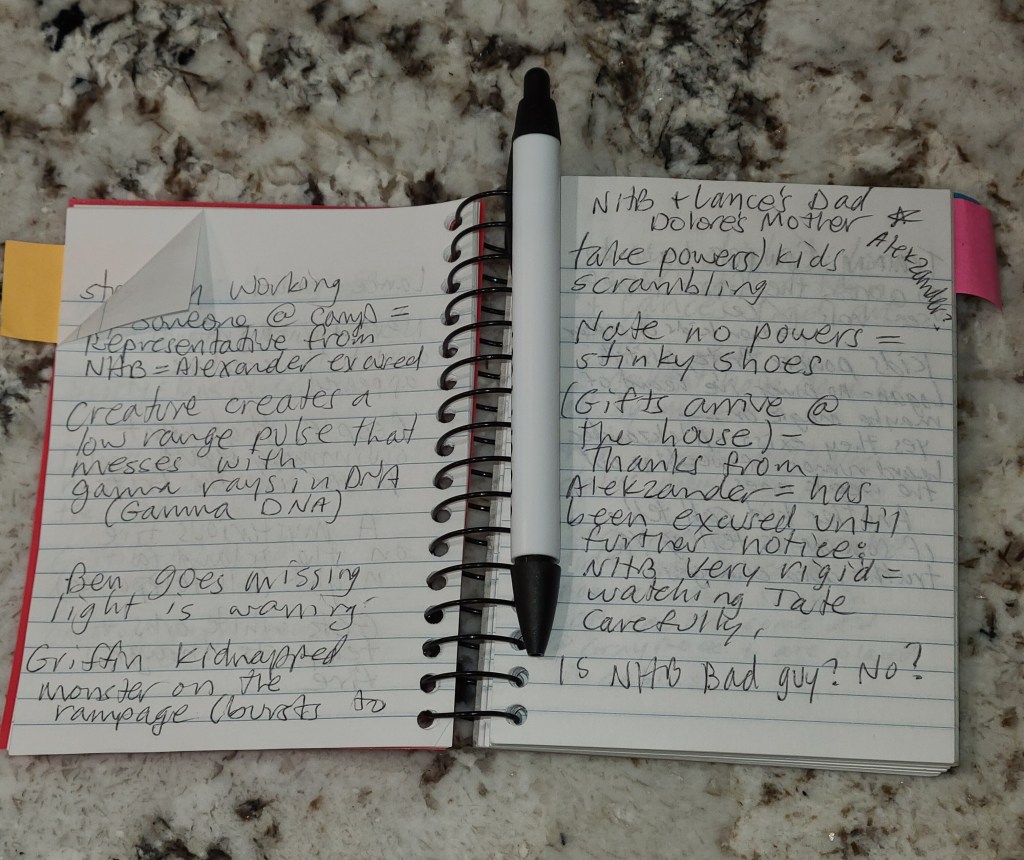
I like to keep a journal close at hand so I can write down ideas that come to me. Here are some ideas you could add to your journal or brainstorming page.
*Jokes you like. I particularly like the BAD DAD JOKES!
*Observations about what people are doing as you drive along in the back seat of your car.
*Your feeling(s) about certain events or activities you’ve participated in.
*Dreams you’ve had.
*Borrowed ideas from other books, movies, songs, or videos you’ve watched…but always remember that authors do not plagiarize (take the work of someone else and say it is your own).
*Map, drawings, or sketches.
 Author Todd Gray